
Design for a Roman Procession
18th century
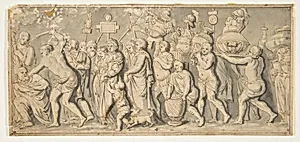
Medium
Pen and brown ink with brush and gray wash on laid paper
Dimensions
sheet: 4 7/16 x 9 1/2 in. (11.2 x 24.2 cm)
Classification
Drawings
Department
Drawings and Prints
Museum
Metropolitan Museum of Art, New York, NY
Credit
The Elisha Whittelsey Collection, The Elisha Whittelsey Fund, 1960
Accession Number
60.632.13
Rights
Public Domain
Tags
Art Historical Context
This exquisite 18th-century French, titled *Design for a Roman Procession*, a glimpse into the era's fascination with classical antiquity. Created anonymously by a skilled draftsman, it depicts a lively procession featuring men, infants, dogs, ornate vases—likely evoking the festive triumphs or Bacchic revels of ancient Rome. Such designs were common preparatory studies for larger decorative projects, like tapestries, wall panels, or furniture ornamentation, reflecting the opulent tastes of French aristocracy during the Rococo period, when artists revived Roman motifs to blend grandeur with elegance. Rendered in pen and brown ink with brush and gray wash on laid paper, the work showcases precise linework for figures and architecture, enhanced by subtle gray tones for depth and movement. The modest sheet size (4 7/16 x 9 1/2 in.) underscores its role as a studio sketch, a technique prized for its economy and expressiveness in 18th-century ateliers. Laid paper, with its characteristic chain lines, authenticates its period craftsmanship. Now in the Metropolitan Museum of Art's Drawings and Prints department, part of The Elisha Whittelsey Collection (acquired 1960), this piece highlights how French artists channeled historical revival into innovative design, bridging ancient spectacle with Enlightenment-era creativity. A charming window into artistic process!
About the Artist
Anonymous, French, 18th century · 1700–1800
The artist known as Anonymous, French, 18th century, represents a collective of unidentified talents active roughly between 1700 and 1800, a period of profound artistic evolution in France from the opulent Rococo to the austere dawn of Neoclassicism and Revolutionary fervor. Little is documented about their personal training or mentors, as their anonymity obscures individual biographies, though th...