
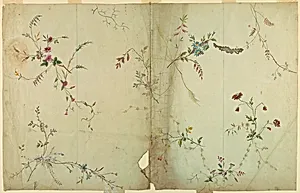
Design for a Silk Brocade
1775–1790
Medium
Drawing
Classification
Drawing
Department
Smithsonian Collection
Museum
Smithsonian American Art Museum
Credit
Gift of Eleanor and Sarah Hewitt
Accession Number
1909-13-132-a
Rights
Public Domain
About this artwork
Research in Progress
Art Historical Context
This delicate *Design for a Silk Bro*, created between 1775 and 1790, offers a glimpse into the refined world of late colonial American textiles. Housed in the Smithsonian American Art Museum as part of the Smithsonian Collection, this drawing—gifted by Eleanor and Sarah—serves as a preparatory blueprint for luxurious woven fabrics. Silk brocade, for its shimmering, raised patterns achieved through complex Jacquard-like weaving techniques, was a status symbol in fashion and home furnishings during the Revolutionary era, European influences with emerging American tastes. As a drawing, the artwork highlights the meticulous preparatory process of textile design, where artists sketched motifs—often floral, neoclassical, or geometric—for weavers to interpret on looms. Though the creator remains unknown and research is ongoing, it reflects the period's booming textile trade, fueled by post-war prosperity and a desire for opulent silks amid simpler Republican ideals. Such designs bridged artistry and industry, influencing gowns, upholstery, and trade goods. Visitors will appreciate how this piece captures the intersection of craft and culture, inviting us to imagine 18th-century seamstresses and merchants bringing these intricate visions to life in vibrant threads. (198 words)
About the Artist
Unknown
The artist designated as "Unknown" in our virtual museum's collection exemplifies a poignant chapter in art history: creators whose identities have faded into obscurity despite the enduring power of their work. With only one known artwork attributed to them in our holdings, this figure represents countless anonymous hands that shaped visual culture across centuries. Museums worldwide, including th...