
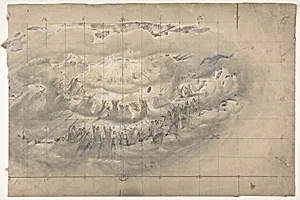
Design for a Stage Set at the Opéra, Paris
1828–90
Medium
Graphite, black chalk, heightened with white
Dimensions
sheet: 10 3/4 x 16 1/16 in. (27.3 x 40.8 cm)
Classification
Drawings
Department
Drawings and Prints
Museum
Metropolitan Museum of Art, New York, NY
Credit
Gift of Mrs. Henry T. Curtis, 1953
Accession Number
53.668.51
Rights
Public Domain
Tags
Art Historical Context
Eugène Cicéri'sDesign for a Stage Set the Opéra, Paris (ca. 1828–90) captures the grandeur of 19th-century theater design. As a leading scene painter for the Paris Opéra during the Romantic era, Cicéri specialized in creating immersive backdrops that transformed stages into evocative worlds. This preparatory drawing likely envisioned a dramatic scene—perhaps a palace interior or fantastical landscape—for one of the Opéra's lavish productions, reflecting the era's obsession with spectacle amid the rise of gas lighting and mechanized scenery. Rendered in graphite, black chalk, and heightened with white on a modest 10 3/4 x 16 1/16-inch sheet, the work showcases Cicéri's masterful technique for suggesting depth, light, and atmosphere. The white gouache highlights mimic moonlight or spotlights, a clever illusion essential for translating two-dimensional sketches into three-dimensional stage magic. Such drawings were vital blueprints, guiding carpenters, painters, and machinists in realizing opulent sets. Housed in the Metropolitan Museum of Art's Drawings and Prints department (gift of Mrs. Henry T. Curtis, 1953), this piece highlights the artistry behind the curtain. It offers a glimpse into how visual innovation fueled cultural icons like the Opéra, blending fine art with performance to enchant audiences in belle époque Paris.
About the Artist
Eugène Cicéri · 1813–1890
Étienne Eugène Cicéri (1813-1890) was a French painter, lithographer, and theatrical designer who became a notable figure in the Barbizon School movement. Born in Paris on January 27, 1813, into an illustrious artistic family, he was the son of renowned scenographer Pierre-Luc-Charles Cicéri and the nephew of painter Eugène Isabey. Cicéri occupies an important position in 19th-century French land...