
Design for Molding
ca. 1825–50
Medium
Graphite, black chalk, heightened with white.
Dimensions
sheet: 5 11/16 x 5 9/16 in. (14.4 x 14.2 cm)
Classification
Drawings
Department
Drawings and Prints
Museum
Metropolitan Museum of Art, New York, NY
Credit
Gift of Regina Slatkin, 1963
Accession Number
63.712.9
Rights
Public Domain
Art Historical Context
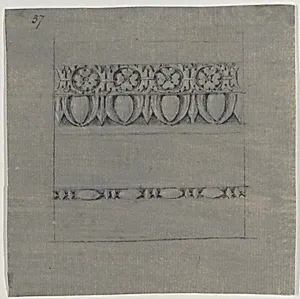
This delicate "Design for Molding," created by an anonymous French artist around 1825–50, captures the elegance of 19th-century ornamental design. Rendered on a compact sheet measuring just 5 11/16 x 5 9/16 inches, it features intricate motifs of egg-and-dart patterns intertwined with blooming flowers—classic elements drawn from ancient Greek and Roman architecture, revived during France's neoclassical and Empire periods. Such designs were essential for architects, furniture makers, and interior decorators, guiding the fabrication of decorative moldings in grand homes, public buildings, and lavish furnishings. The artwork showcases masterful mixed-media techniques typical of preparatory drawings from the era: precise graphite lines define the contours, black chalk adds depth and shadow, and white heightening creates luminous highlights, mimicking the polished sheen of finished plaster or wood moldings. This approach allowed artisans to visualize three-dimensional effects on a flat surface, bridging the gap between concept and craftsmanship. Housed in the Metropolitan Museum of Art's Drawings and Prints department as a gift from Regina Slatkin in 1963, this anonymous gem offers a window into the collaborative workshops of 19th-century France, where skilled draftsmen produced patterns that adorned the opulent spaces of the Romantic age. It reminds us how everyday decorative arts embodied timeless beauty and technical ingenuity.
About the Artist
Anonymous, French, 19th century · 1800–1900
**Anonymous, French, 19th Century (ca. 1800–1900)** The artist cataloged as Anonymous, French, 19th century embodies the enigmatic yet essential contributions of unidentified creators to France's vibrant 19th-century art world. Active roughly between 1800 and 1900, this figure—or potentially collective workshop—produced a diverse array of works amid the nation's transition from Neoclassicism thro...