
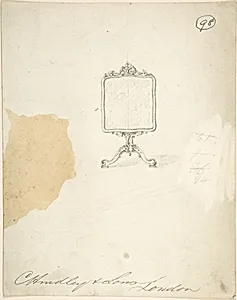
Design for a Standing Frame
1841–84
Medium
Graphite
Dimensions
sheet: 9 1/16 x 7 3/16 in. (23 x 18.2 cm)
Classification
Drawings|Ornament & Architecture
Department
Drawings and Prints
Museum
Metropolitan Museum of Art, New York, NY
Credit
Harris Brisbane Dick Fund, 1946
Accession Number
46.38.79
Rights
Public Domain
Art Historical Context
This delicate graphite drawing, titled *Design for a Standing Frame comes from the workshop of Charles Hindley and, a renowned London firm of upholsterers and cabinet active from 1841 to 1884. Created during the height of the Victorian era, it exemplifies the meticulous preparatory sketches that fueled Britain's booming decorative arts industry. Standing frames—likely elegant easels or picture supports—were essential for displaying artwork, photographs, or mirrors in fashionable homes, blending functionality with ornate style. Rendered in graphite on a modest 9 1/16 x 7 3/16-inch sheet, the design highlights the precision of 19th-century drafting techniques. Fine lines and subtle shading allowed designers like those at Hindley & Sons to visualize complex joinery, proportions, and embellishments before committing to costly production. Such drawings were vital in an age of revival styles, from Gothic to Rococo, reflecting the era's obsession with historicism and craftsmanship amid the Industrial Revolution's rise. Housed in the Metropolitan Museum of Art's Drawings and Prints department, this piece offers a window into the behind-the-scenes artistry of Victorian ornament and architecture. It reminds us how everyday objects were elevated to status symbols through thoughtful design.
About the Artist
Charles Hindley and Sons · 1841–1917
**Charles Hindley and Sons: Victorian Masters of Furnishing Design** Charles Hindley and Sons was a premier British cabinet-making and upholstery firm based in London, operating primarily from 134 Oxford Street. Established around 1820 by Charles Hugh Hindley, a furniture maker and upholsterer initially on Berners Street, the firm expanded significantly in 1844 by acquiring the rival establishmen...