
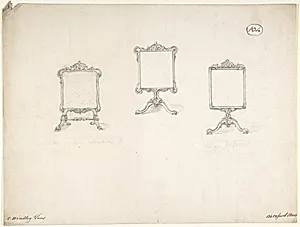
Designs for Three Screens
1841–84
Medium
Graphite
Dimensions
sheet: 9 7/8 x 13 1/8 in. (25.1 x 33.3 cm)
Classification
Drawings|Ornament & Architecture
Department
Drawings and Prints
Museum
Metropolitan Museum of Art, New York, NY
Credit
Harris Brisbane Dick Fund, 1946
Accession Number
46.38.30
Rights
Public Domain
Tags
Art Historical Context
"Designs for Three Screens by Charles Hindley and, created between 1841 and 1884, offers a fascinating glimpse into Victorian-era decorative arts. Rendered in graphite on a modest sheet measuring 9 7/8 x 13 1/8 inches, this drawing from the Metropolitan Museum of Art's Drawings and Prints captures preliminary concepts for ornate room screens. These multifunctional pieces—likely intended as fire screens or room dividers—were staples of 19th-century interiors, blending utility with elaborate ornamentation. As part of the Ornament & Architecture classification, the work reflects the meticulous planning behind Britain's booming furniture and design industry during the Industrial Revolution. Hindley and Sons, a prominent firm, specialized in such commissioned sketches, using graphite's precision to outline intricate patterns and structural details. This technique allowed designers to refine ideas affordably before costly production, highlighting the era's fusion of craftsmanship and emerging mass manufacturing. Today, preserved through the Harris Brisbane Dick Fund of 1946, this artifact underscores the artistic value of preparatory drawings. It invites visitors to appreciate how simple pencil lines laid the groundwork for the opulent homes of the Victorian age, bridging architecture, design, and everyday elegance.
About the Artist
Charles Hindley and Sons · 1841–1917
**Charles Hindley and Sons: Victorian Masters of Furnishing Design** Charles Hindley and Sons was a premier British cabinet-making and upholstery firm based in London, operating primarily from 134 Oxford Street. Established around 1820 by Charles Hugh Hindley, a furniture maker and upholsterer initially on Berners Street, the firm expanded significantly in 1844 by acquiring the rival establishmen...