
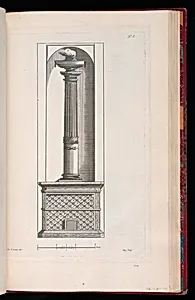
Design for a Stove
Classification
Department
Smithsonian Collection
Museum
Smithsonian American Art Museum
Credit
Purchased for the Museum by the Advisory Council
Accession Number
1921-6-332-129
Rights
Public Domain
About this artwork
Research in Progress
Art Historical Context
**Design for a Stove** by Richard de Lalonde, a French designer active from 1780 to 1796, dates to the 1780s—a pivotal era in France just before the Revolution. This print captures the elegance of Neoclassicism, a movement drawing inspiration from ancient Greek and Roman motifs to revive symmetry, proportion, and refined ornamentation in decorative arts. Lalonde specialized in such designs for furniture, interiors, and architectural elements, making his work essential for disseminating sophisticated tastes among the aristocracy and emerging bourgeoisie. As a print, this artwork served a practical purpose: it acted as a blueprint for artisans crafting luxury stoves, which were both functional heating devices and statement pieces in grand salons. Though the exact medium remains under study, prints like this were vital in the 18th-century design trade, allowing precise replication of intricate details—from fluted columns to garlands—across workshops. Acquired by the Smithsonian American Art Museum through its Advisory Council, it highlights cross-Atlantic appreciation for French ingenuity. This piece invites us to imagine opulent 18th-century homes, where form met function in harmonious beauty. Ongoing research promises deeper insights into Lalonde's contributions to the decorative revolution. (198 words)