
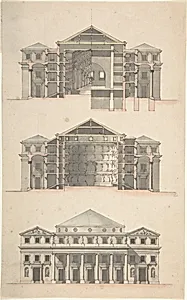
Design for a Theatre
18th century
Medium
Pen and black ink, brush and rose wash over graphite
Dimensions
plate: 11 1/4 x 7 in. (28.6 x 17.8 cm)
Classification
Drawings|Ornament & Architecture
Department
Drawings and Prints
Museum
Metropolitan Museum of Art, New York, NY
Credit
Gift of Mr. and Mrs. Charles Wrightsman, 1970
Accession Number
1970.736.6a
Rights
Public Domain
Tags
Art Historical Context
Step into the opulent world of 18-century French theatre with this delicate *Design for a Theatre*, anonymous architectural drawing from the Metropolitan Museum of Art's Drawings and Prints collection. during the Enlightenment era, theatre was a vibrant hub of social and cultural life—from royal courts to public spectacles—this work reflects the era's passion for dramatic spaces that blended grandeur with intimacy. Gifted by Mr. and. Charles Wrightsman 1970, it a compact 11¼ x 7 inches, inviting close inspection of its intricate details. The artist employed a meticulous mixed-media technique: graphite underdrawing for initial planning, fine pen and black ink for precise lines defining arches, prosceniums, and ornate ornamentation, and subtle brush-applied rose wash for a warm, atmospheric glow. This combination was typical of period architectural renderings, evoking luxurious materials like stucco and velvet while highlighting functional elegance in theatre design—spaces meant to enchant audiences with illusion and spectacle. As a classified example of ornament and architecture, this drawing offers a window into France's neoclassical leanings amid lingering Rococo flourishes, underscoring theatre's role as a cultural powerhouse. A testament to the artistry of the unseen designer, it reminds us how sketches like this shaped the stages of history.
About the Artist
Anonymous, French, 18th century · 1700–1800
The artist known as Anonymous, French, 18th century, represents a collective of unidentified talents active roughly between 1700 and 1800, a period of profound artistic evolution in France from the opulent Rococo to the austere dawn of Neoclassicism and Revolutionary fervor. Little is documented about their personal training or mentors, as their anonymity obscures individual biographies, though th...