
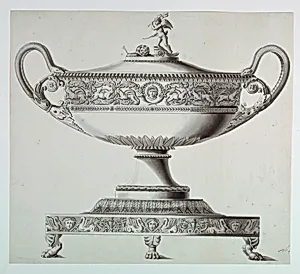
Design for a Tureen
Classification
metalwork
Department
Smithsonian Collection
Museum
Smithsonian American Art Museum
Credit
Purchased for the Museum by the Advisory Council
Accession Number
1911-28-359
Rights
Public Domain
About this artwork
Research in Progress
Art Historical Context
This design for a tureen, created by German artist Joseph Anton Seethaler II between 1825 and 1835, offers a glimpse into the refined world of nineteenth-century European metalwork. As a preparatory study rather than a finished object, it reveals the careful planning behind elegant tableware intended for formal dining. Seethaler, active during a period when German craftsmanship blended neoclassical restraint with emerging romantic sensibilities, likely envisioned this piece in silver or another fine metal, reflecting the era’s emphasis on both utility and decorative grace. Housed in the Smithsonian American Art Museum’s collection, the drawing highlights how artists contributed to the applied arts, shaping everyday luxury items that adorned aristocratic and bourgeois homes alike. Though research on the work remains ongoing, its classification as metalwork underscores the technical skill required to translate two-dimensional ideas into three-dimensional forms. Visitors can appreciate how such designs bridged fine art and functional craftsmanship, preserving a moment when dining rituals carried significant social meaning.