
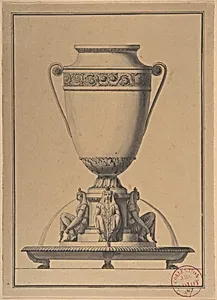
Design for a Wine Fountain
ca. 1770–1816
Medium
Pen, black ink with brush and gray wash
Dimensions
10 3/16 x 7 1/16in. (25.8 x 18cm)
Classification
Drawings|Ornament & Architecture
Department
Drawings and Prints
Museum
Metropolitan Museum of Art, New York, NY
Credit
Rogers Fund and The Elisha Whittelsey Collection, The Elisha Whittelsey Fund, 1978
Accession Number
1978.521.10
Rights
Public Domain
Tags
Art Historical Context
Henri Auguste’s *Design for a Wine Fountain*, created around 1770–1816, is a delicate preparatory drawing that captures the grandeur of 18th-century ornamental architecture. Rendered in pen and black ink with brush and gray wash on paper (10 3/16 x 7 1/16 in.), this work exemplifies the meticulous techniques used by designers of the era to envision elaborate public and garden features. The gray wash adds subtle tonal depth, suggesting stone textures and flowing water, while precise ink lines define architectural forms—perfect for pitching ideas to patrons or craftsmen. Likely intended for a festive outdoor setting, the design features fountain elements adorned with female figures, evoking classical motifs of abundance and revelry. Wine fountains were symbols of celebration in European courts and gardens, blending utility with opulence during the late Rococo to Neoclassical transition. Auguste, a French ornamental designer, contributed to this tradition of decorative innovation amid social upheavals like the French Revolution. Housed in The Metropolitan Museum of Art’s Drawings and Prints department, this piece highlights the artistry behind functional splendor. It invites us to appreciate how such sketches bridged imagination and reality, influencing the lavish landscapes of the Enlightenment age.
About the Artist
Henri Auguste · 1759–1816
**Henri Auguste (1759–1816)** was a leading Parisian gold- and silversmith renowned for his elegant neoclassical and Empire-style works in *orfèvrerie*. As the only son of the royal goldsmith Robert-Joseph Auguste (1723–1805), he assumed ownership of his father’s workshop in 1784–85 and carried forward the family tradition of refined, classically inspired silverware. Auguste collaborated closely ...