
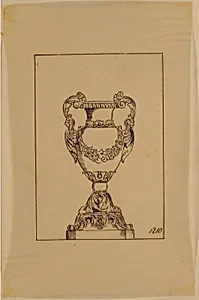
Design for an Urn
19th century
Medium
Pen and brown ink. Framing lines in pen and brown ink.
Dimensions
sheet: 9 1/8 x 6 in. (23.1 x 15.2 cm)
Classification
Drawings
Department
Drawings and Prints
Museum
Metropolitan Museum of Art, New York, NY
Credit
Rogers Fund, 1966
Accession Number
66.631.133
Rights
Public Domain
Tags
Art Historical Context
This delicate "Design for an Urn created by an anonymous French artist in the 19th, offers a glimpse into the elegant world of ornamental design from that era. Rendered on a modest sheet measuring 9 1/8 x 6 inches, the drawing features intricate motifs of garlands and urn—classic symbols of abundance, fertility, and classical antiquity that were revived during France's Romantic and Second Empire periods. Such designs were likely preparatory sketches for luxury objects like ceramics, furniture, or architectural elements, reflecting the era's fascination with Greco-Roman aesthetics amid rapid industrialization and neoclassical revivals. Executed in pen and brown ink with framing lines in the same medium, the work showcases the precision and fluidity of ink techniques favored by French ateliers. Brown ink, often derived from natural pigments, allowed for subtle tonal variations and fine detailing, making it ideal for capturing the flowing curves of garlands draping over ornate urns. This drawing exemplifies the collaborative, anonymous craft of design workshops, where skilled draftsmen translated ideas into manufacturable forms. Acquired through the Rogers Fund in 1966 and housed in the Metropolitan Museum of Art's Drawings and Prints department, this piece highlights the artistry behind everyday opulence, inviting visitors to appreciate the unsung creativity that shaped 19th-century French decorative arts.
About the Artist
Anonymous, French, 19th century · 1800–1900
**Anonymous, French, 19th Century (ca. 1800–1900)** The artist cataloged as Anonymous, French, 19th century embodies the enigmatic yet essential contributions of unidentified creators to France's vibrant 19th-century art world. Active roughly between 1800 and 1900, this figure—or potentially collective workshop—produced a diverse array of works amid the nation's transition from Neoclassicism thro...