
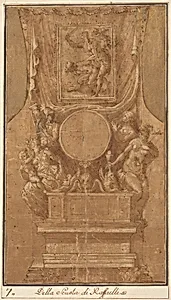
Design for an Altar
1501 to 1550
Medium
pen and brown ink with brown wash and white heightening over black chalk
Dimensions
Overall: 41.7 x 29.8 cm (16 7/16 x 11 3/4 in.) support: 28 x 16 cm (11 x 6 5/16 in.)
Classification
Drawing
Department
CG-E
Museum
National Gallery of Art, Washington, D.C.
Credit
Julius S. Held Collection
Accession Number
1985.1.52
Rights
Public Domain
Art Historical Context
Francesco Salviati, an Italian artist active during the height of the Mannerist period, created this preparatory drawing as a design for an altar between 1501 and 1550. Working in Florence and Rome, Salviati was renowned for his elegant, elongated figures and sophisticated decorative schemes that adorned churches and palaces across Italy. Altar designs like this one played a vital role in the Catholic Church’s artistic patronage, helping patrons visualize complex religious compositions before they were executed in paint or marble. The drawing’s medium—pen and brown ink with brown wash and white heightening over black chalk—reveals the careful layering artists used to suggest light, shadow, and three-dimensional form. White highlights bring a luminous quality to the architectural elements and figures, while the wash adds depth and atmosphere. Such studies allowed Salviati to refine his ideas on a modest scale before committing to larger, more costly projects. Today preserved in the National Gallery of Art’s collection, this sheet offers visitors a rare glimpse into the creative process behind Mannerist religious art. It demonstrates how even preparatory works could achieve remarkable beauty and technical mastery.