
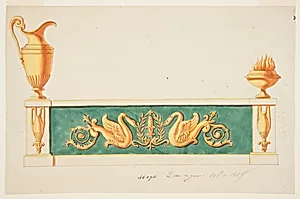
Design for an Andiron
early 19th century
Classification
metalwork
Department
Smithsonian Collection
Museum
Smithsonian American Art Museum
Credit
Gift of Eleanor and Sarah Hewitt
Accession Number
1931-64-160
Rights
Public Domain
About this artwork
Research in Progress
Art Historical Context
This elegant *Design for an Andiron from the Lefebvre Manactory in Tournai Belgium, dates to the early 19th century, a period when neoclassical influences blended with emerging industrial techniques in European metalwork. Andirons, or fire dogs, were essential household items used to elevate logs in fireplaces, elevating them from mere utility to symbols of refined domesticity. Produced by Tournai's skilled manufactories—renowned for their bronze and iron casting—these designs often featured ornate motifs inspired by classical antiquity, reflecting the era's fascination with symmetry, mythology, and grandeur. As a preparatory drawing or model, this piece highlights the meticulous planning behind functional art. Lefebvre's workshop contributed to the burgeoning field of decorative metalwork, bridging artisanal craftsmanship with mass production amid the Napoleonic aftermath and Industrial Revolution. Though the exact medium remains under study (research in progress), its metalwork classification underscores the technical prowess of cast and chased surfaces that would bring hearths to life with shimmering detail. Now part of the Smithsonian American Art Museum's collection—thanks to the generous gift of Eleanor and Sarah Hewitt—this artifact invites us to appreciate how everyday objects embodied cultural aspirations, warming both homes and hearts in a pre-central-heating world.