
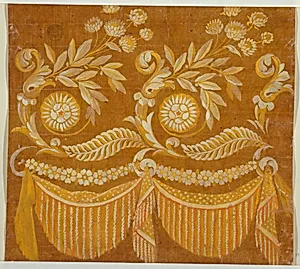
Design for an Embroidered Horizontal Border of the "Fabrique de St. Ruf"
1800–1825
Classification
Drawing
Department
Smithsonian Collection
Museum
Smithsonian American Art Museum
Credit
Gift of Eleanor and Sarah Hewitt
Accession Number
1914-21-107
Rights
Public Domain
About this artwork
Research in Progress
Art Historical Context
This delicate *Design for an Embro Horizontal Border* from the Fabrique de Saint Ruf in Lyon, France (1800–1825) offers a glimpse into the world of early 19th-century textile design. Created as a preparatory drawing, served as a blueprint for intricate embroidery, capturing the precision required to translate artistic concepts into luxurious fabrics. Lyon's status as a global hub for silk weaving and textile innovation during the Napoleonic era and Restoration period made workshops like Saint Ruf vital to France's export-driven economy, blending craftsmanship with emerging industrial techniques. Though the exact medium remains unidentified and research is ongoing, such designs exemplify the fusion of fine art and applied arts. Horizontal borders like this would have adorned garments, furnishings, or ecclesiastical textiles, reflecting Neoclassical motifs transitioning toward Romantic flourishes. Produced amid post-Revolutionary recovery, it underscores how French *fabriques* (workshops) sustained opulent traditions for elite international markets. A cherished gift from collectors Eleanor and Sarah Hewitt to the Smithsonian American Art Museum, this piece bridges European design heritage with American collections, inviting us to appreciate the unsung artistry behind embroidered splendor. (198 words)