
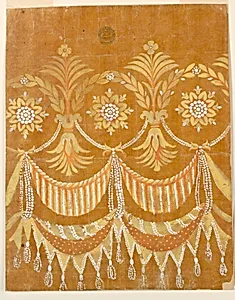
Design for an Embroidered Horizontal Border of the "Fabrique de St. Ruf"
1800–1825
Classification
Drawing
Department
Smithsonian Collection
Museum
Smithsonian American Art Museum
Credit
Gift of Eleanor and Sarah Hewitt
Accession Number
1914-21-110
Rights
Public Domain
About this artwork
Research in Progress
Art Historical Context
This delicate drawing, titled *Design for an Embro Horizontal Border of the "rique de St. Ruf*, hails from the textile workshops of Lyon,—Europe's silk capital the early 19th century. between 1800 and 1825 by the Fabrique de Saint Ruf, a prominent manufactory, it served as a precise pattern for luxurious embroidered borders. Lyon’s silk industry flourished in this era, producing opulent fabrics for fashion, furnishings, and export, even amid the turbulence of the Napoleonic Wars and Restoration period. These designs fueled France's global reputation for exquisite textiles, blending neoclassical elegance with emerging Empire style motifs. As a preparatory drawing (medium unspecified), it exemplifies the meticulous craftsmanship of textile designers, who translated intricate patterns onto looms and needles for embroidery. Such borders might have adorned shawls, dresses, or upholstery, showcasing floral or geometric repeats typical of the time. Donated to the Smithsonian American Art Museum by collectors Eleanor and Sarah Hewitt, this piece highlights the transatlantic appreciation for French decorative arts. Though research continues, it offers a window into the innovative world of Lyon's *fabricants*, where artistry met industry to create enduring luxury.