
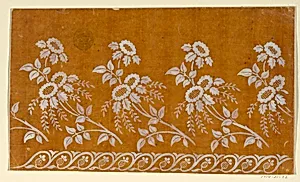
Design for an Embroidered or Woven Horizontal Border of the "Fabrique de St. Ruf"
1805–1815
Medium
Drawing
Classification
Drawing
Department
Smithsonian Collection
Museum
Smithsonian American Art Museum
Credit
Gift of Eleanor and Sarah Hewitt
Accession Number
1914-21-92
Rights
Public Domain
About this artwork
Research in Progress
Art Historical Context
This elegant drawing, titled *Design for an Embroidered oroven Horizontal Border of the "Fabrique de St."*, originates from the Fabrique de Saint Ruf, textile workshop in Lyon, France—Europe's silk-weaving capital—dated to 1805–1815. As a preparatory sketch in the medium of drawing, it functioned as a pattern template for creating intricate horizontal borders, likely intended for embroidery or loom-woven textiles like ribbons, trims, or furnishing edges. During the Napoleonic and early Restoration, Lyon's manufactories like Saint Ruf produced luxurious silks that defined high fashion and interior design across Europe and beyond. Such designs bridged artistic creativity with industrial precision, enabling weavers to replicate motifs on advanced looms or by hand, reflecting the period's blend of neoclassical elegance and technical innovation. Today, this work graces the Smithsonian American Art Museum's collection, a gift from collectors Eleanor and Sarah Hewitt. With ongoing research, it invites us to appreciate the unseen artistry behind 19th-century opulence, connecting visitors to Lyon's enduring textile legacy.