
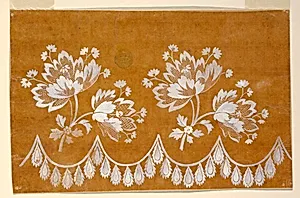
Design for an Embroidered or Woven Horizontal Border of the "Fabrique de St. Ruf," Unfinished
1805–1815
Classification
Drawing
Department
Smithsonian Collection
Museum
Smithsonian American Art Museum
Credit
Gift of Eleanor and Sarah Hewitt
Accession Number
1914-21-69
Rights
Public Domain
About this artwork
Research in Progress
Art Historical Context
Step into the world of early 19th-century French design with this unfinished *Design for an Embro or Woven Horizontal Border* from the Fabrique de Ruf, a renowned silk workshop in Lyon, France, dating to 1805–1815. Lyon was Europe's silk capital during the Napoleonic era, where master weavers and designers created intricate patterns for luxurious fabrics destined for gowns, furnishings, and exports. This drawing, classified as a preparatory sketch, captures the meticulous planning behind woven or embroidered borders—repeating motifs that added elegance and rhythm to textiles. As an artifact from the Empire period, it reflects the opulent neoclassical tastes favored by Napoleon’s court, blending floral or geometric elements (inferred from typical Lyon styles) with technical precision for jacquard looms or needlework. Its unfinished state offers a rare glimpse into the creative process, where artists iterated designs on paper before committing to costly production. Though the medium remains unidentified amid ongoing research, such drawings were essential blueprints in Lyon's competitive industry. Today, this piece graces the Smithsonian American Art Museum, a gift from collectors Eleanor and Sarah Hewitt, highlighting the transatlantic appeal of French decorative arts. It invites us to appreciate the unseen labor behind sumptuous silks that shaped fashion and interiors. (198 words)