
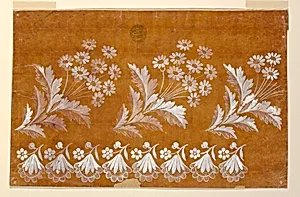
Design for an Embroidered or Woven Horizontal Border of the "Fabrique de St. Ruf"
1805–1815
Medium
Drawing
Classification
Drawing
Department
Smithsonian Collection
Museum
Smithsonian American Art Museum
Credit
Gift of Eleanor and Sarah Hewitt
Accession Number
1914-21-116
Rights
Public Domain
About this artwork
Research in Progress
Art Historical Context
Step into the world of early 19th-century French textile artistry with this delicate *Design for an Embroidered or Woven Horizontal Border* from the Fabrique de Saint Ruf in Lyon, France, created between 1805 and 1815. Lyon, long renowned as Europe's silk-weaving capital, was at its peak during the Napoleonic Empire, producing luxurious fabrics that adorned imperial courts and fashionable homes across continents. This drawing captures the ingenuity of the Fabrique de Saint Ruf, a prominent workshop specializing in intricate woven and embroidered borders—repeating motifs perfect for edging shawls, dresses, or furnishings. As a preparatory drawing, this work reveals the meticulous design process behind Lyon's textile mastery. Artists sketched patterns on paper to guide Jacquard looms or embroiderers, blending neoclassical motifs with Empire-style elegance: think symmetrical floral garlands, urns, or acanthus leaves evoking ancient Rome, revived under Napoleon. Such designs were not just decorative but economically vital, fueling France's export trade to America and beyond. Now housed in the Smithsonian American Art Museum's Smithsonian Collection—thanks to the generous gift of Eleanor and Sarah Hewitt—this piece highlights the transatlantic exchange of style and craft. Though research continues, it invites us to appreciate the unseen labor that wove beauty into everyday luxury. (198 words)