
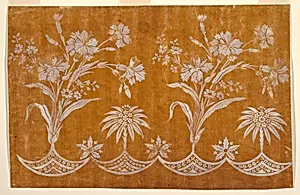
Design for an Embroidered or Woven Horizontal Border of the "Fabrique de St. Ruf"
1805–1815
Medium
Drawing
Classification
Drawing
Department
Smithsonian Collection
Museum
Smithsonian American Art Museum
Credit
Gift of Eleanor and Sarah Hewitt
Accession Number
1914-21-99
Rights
Public Domain
About this artwork
Research in Progress
Art Historical Context
This delicate drawing, titled *Design for an Embroidered oroven Horizontal Border of theFabrique de St."*, hails from the renowned Fabrique de Saint Ruf, prestigious silk manufactory in Lyon, France during the early 19th century (1805–1815). Lyon was Europe's silk capital, and factories like Saint Ruf specialized in luxurious textiles for fashion and furnishings, fueling the Napoleonic Empire's opulent aesthetic. As a preparatory drawing, it captures the meticulous planning behind woven or embroidered borders—repeating motifs likely intended for garments, shawls, or upholstery, showcasing the era's neoclassical influences with precise lines and intricate patterns. Created as a blueprint for production, this work highlights the artistry of textile design, where draftsmen translated ideas into looms or embroidery frames using ink, watercolor, or pencil on paper. Such designs were vital to Lyon's economy, blending technical precision with decorative flair to meet demand from elite European markets. Though research continues, it exemplifies the fusion of craft and commerce in the Age of Empire. Today, housed in the Smithsonian American Art Museum's Smithsonian Collection (gift of Eleanor and Sarah Hewitt), it offers a window into forgotten design processes, reminding us how everyday luxury was born from such humble sketches.