
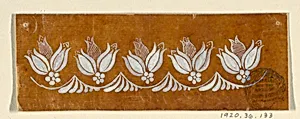
Design for an Embroidered or Woven Horizontal Border of the "Fabrique de St. Ruf"
1805–1815
Medium
Drawing
Classification
Drawing
Department
Smithsonian Collection
Museum
Smithsonian American Art Museum
Credit
Gift of Eleanor and Sarah Hewitt
Accession Number
1920-36-133
Rights
Public Domain
About this artwork
Research in Progress
Art Historical Context
This delicate drawing, titled *Design for an Emidered or Woven Horizontal of the "Fabrique de St."*, hails from the renowned Fabrique de Saint Ruf in, France, a hub of textile innovation during the early 19th century (1805–1815). Created as a preparatory sketch, it served as a blueprint for luxurious embroidered or woven borders, showcasing the precision and elegance typical of Lyon's silk-weaving mastery. Now part of the Smithsonian American Art Museum collection—thanks to the generous gift of Eleanor and Sarah Hewitt—this invites us into the workshops where designs like this transformed threads into opulent fabrics. Lyon's textile industry flourished under Napoleon's Empire, producing intricate patterns that blended neoclassical motifs with emerging Romantic flourishes, often destined for elite wardrobes across Europe and America. The Fabrique de Saint Ruf exemplified this craft, employing skilled designers to create repeatable borders that adorned shawls, dresses, and furnishings. As a drawing, it highlights the artistic technique of pattern drafting—meticulous ink and watercolor work on paper—essential for scaling ideas into looms or embroidery frames. Though research continues, this artifact whispers of globalization's early threads: French ingenuity crossing oceans to influence American tastes. Imagine the glamour of a gown edged with such a border, a testament to craftsmanship that bridged art and commerce.