
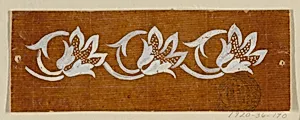
Design for an Embroidered or Woven Horizontal Border of the "Fabrique de St. Ruf"
1800–1815
Classification
Drawing
Department
Smithsonian Collection
Museum
Smithsonian American Art Museum
Credit
Gift of Eleanor and Sarah Hewitt
Accession Number
1920-36-170
Rights
Public Domain
About this artwork
Research in Progress
Art Historical Context
This delicate drawing, titled *Design for an Embroidered oroven Horizontal Border of theFabrique de St."*, hails from the renowned silkactory Fabrique de Saint in Lyon, France, to 1800–1815. Created as a preparatory sketch, it served as a blueprint for textile production—likely envisioning intricate patterns for embroidered or woven borders on luxurious fabrics such as shawls, ribbons, or garments. Lyon's silk industry was at its zenith during this era, powering France's textile trade and employing innovative designers to craft motifs that blended elegance with technical precision. The piece reflects the Neoclassical influences of the Napoleonic period, when Lyonnaise weavers adapted classical motifs to fashionable Empire-style textiles destined for elite wardrobes across Europe and America. As a drawing from this pivotal hub of innovation, it highlights the collaborative artistry behind silk fabrication, where designers translated ideas into looms via detailed patterns. Though the exact medium remains unidentified amid ongoing research, such works were essential for scaling production while preserving ornamental finesse. Now part of the Smithsonian American Art Museum's collection—generously gifted by Eleanor and Sarah Hewitt—this artifact offers a window into 19th-century craft mastery, reminding us how everyday luxury was born from meticulous design.