
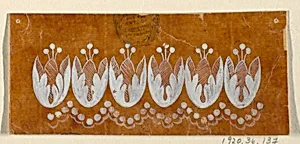
Design for an Embroidered or Woven Horizontal Border of the "Fabrique de St. Ruf"
1805–1815
Classification
Drawing
Department
Smithsonian Collection
Museum
Smithsonian American Art Museum
Credit
Gift of Eleanor and Sarah Hewitt
Accession Number
1920-36-137
Rights
Public Domain
About this artwork
Research in Progress
Art Historical Context
This delicate drawing, titled *Design for an Embroidered oroven Horizontal Border of theFabrique de St."*, hails from the renowned textile manufactory Fabrique Saint Ruf in Lyon, France, dating to 1805–1815. as a preparatory sketch, it served as a blueprint for luxurious embroidered or woven borders, showcasing the precision required in high-end fabric production. Now part of the Smithsonian American Art's collection, thanks to a gift from Eleanor and Sarah Hewitt, offers a glimpse into the artistry behind everyday opulence. Lyon, Europe's silk weaving capital during the Napoleonic era, was a hub of innovation where factories like Saint Ruf produced intricate designs for fashion, furnishings, and exports. This period saw a blend of neoclassical motifs with emerging Empire style—think bold symmetries and refined patterns suited for ribbons, trims, or garment edges. As a drawing, it highlights the meticulous drafting techniques essential to textile design, where every line anticipated the loom's or needle's translation into shimmering silks. Though research continues, this artifact underscores Lyon's cultural dominance in textiles, bridging fine art and craft. Imagine it adorning a gown or curtain, a testament to French ingenuity that influenced global tastes.