
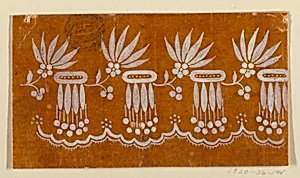
Design for an Embroidered or Woven Horizontal Border of the "Fabrique de St. Ruf"
1805–1815
Medium
Drawing
Classification
Drawing
Department
Smithsonian Collection
Museum
Smithsonian American Art Museum
Credit
Gift of Eleanor and Sarah Hewitt
Accession Number
1920-36-145
Rights
Public Domain
About this artwork
Research in Progress
Art Historical Context
This delicate drawing, titled *Design for an Embro or Woven Horizontal Border the "Fabrique de. Ruf"*, hails from the renowned textile hub of Lyon, France, created between 1805 and 1815 by the Fabrique de Saint Ruf workshop. Lyon was Europe's silk capital during this era, producing luxurious fabrics for fashion, furnishings, and export worldwide. As a preparatory design on paper, it served as a blueprint for embroidered or woven borders—repeating motifs essential for efficient textile production on Jacquard looms, which revolutionized weaving around this time. Such drawings were vital tools in the competitive world of French textile manufacturing, capturing intricate patterns that blended neoclassical elegance with emerging Empire style influences under Napoleon. The Fabrique de Saint Ruf exemplified Lyon's guild-trained artisans, whose innovations helped sustain the city's economy amid post-Revolutionary upheaval. Though research continues, this piece highlights the fusion of artistry and industry. Now in the Smithsonian American Art Museum's collection—generously gifted by collectors Eleanor and Sarah Hewitt—it offers a window into 19th-century design processes, reminding us how humble sketches birthed opulent textiles adorning global elites. A testament to craftsmanship's enduring allure!