
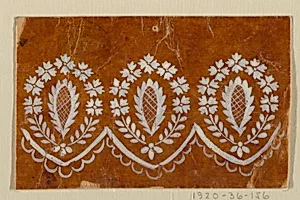
Design for an Embroidered or Woven Horizontal Border of the "Fabrique de St. Ruf"
1805–1815
Medium
Drawing
Classification
Drawing
Department
Smithsonian Collection
Museum
Smithsonian American Art Museum
Credit
Gift of Eleanor and Sarah Hewitt
Accession Number
1920-36-156
Rights
Public Domain
About this artwork
Research in Progress
Art Historical Context
This delicate drawing, titled *Design for an Embro or Woven Horizontal Border the "Fabrique de St. Ruf"*, hails from the renowned textile hub of Lyon, France, created by the Fabrique de Saint Ruf workshop between 1805 and1815. As a preparatory sketch in ink or pencil—typical of the era's design process—it served as a blueprint for luxurious silk borders destined for embroidery or weaving on advanced looms. Lyon's silk industry, a cornerstone of French craftsmanship since the Renaissance, peaked during the Napoleonic period, producing opulent fabrics for gowns, furnishings, and exports that dazzled European and American elites. The drawing captures the precision of early 19th-century textile design, when innovations like Joseph-Marie Jacquard's programmable loom (patented in 1801) revolutionized pattern complexity. Fabrique de Saint Ruf, one of Lyon's esteemed manufactories, specialized in such intricate borders, blending neoclassical elegance with emerging Empire style motifs—likely floral or geometric repeats suited for trimmings. Its presence in the Smithsonian American Art Museum, gifted by design enthusiasts Eleanor and Sarah Hewitt in the early 20th century, highlights transatlantic exchanges in decorative arts, bridging French innovation with American collecting tastes. Though research continues, this artifact offers a window into the artistry behind everyday luxury, reminding us how a simple design sketch fueled an industry's global influence.