
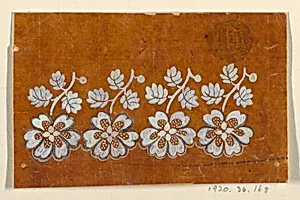
Design for an Embroidered or Woven Horizontal Border of the "Fabrique de St. Ruf"
1800–1815
Medium
Drawing
Classification
Drawing
Department
Smithsonian Collection
Museum
Smithsonian American Art Museum
Credit
Gift of Eleanor and Sarah Hewitt
Accession Number
1920-36-168
Rights
Public Domain
About this artwork
Research in Progress
Art Historical Context
This delicate drawing, titled *Design for an Embroidered or Woven Horizontal Border of the "Fabrique de St. Ruf"*, hails from the renowned silk manufactory Fabrique de Saint Ruf in Lyon, France, dating to the early 19th century (1800–1815). Lyon was Europe's silk weaving capital during this era, producing luxurious textiles for fashion and furnishings that defined Napoleonic elegance. As a preparatory design, it served as a blueprint for artisans to embroider or weave intricate borders, likely featuring repeating motifs suited to shawls, dresses, or upholstery—hallmarks of the Empire style's opulent neoclassicism. Created as a simple yet precise drawing, this work exemplifies the technical drawings essential to textile production. These patterns ensured symmetry and scalability in looms or needles, bridging artistic creativity with industrial precision. Produced amid France's post-Revolutionary textile boom, it reflects how Lyon's workshops adapted to imperial tastes, blending floral exuberance with geometric restraint. Generously gifted to the Smithsonian American Art Museum by Eleanor and Sarah Hewitt, this piece from the Smithsonian Collection invites us to appreciate the unseen labor behind historic fabrics. Though research continues, it offers a window into the craft that dressed Europe's elite.