
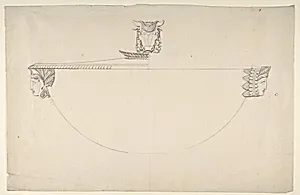
Design for an Empire Covered Dish
ca. 1810–15
Medium
Pen and black ink
Dimensions
sheet: 10 3/16 x 15 7/8 in. (25.9 x 40.3 cm)
Classification
Drawings
Department
Drawings and Prints
Museum
Metropolitan Museum of Art, New York, NY
Credit
The Elisha Whittelsey Collection, The Elisha Whittelsey Fund, 1977
Accession Number
1977.658
Rights
Public Domain
Tags
Art Historical Context
This delicate pen and black ink drawing, titled *Design for an Empire Covered Dish*, dates to around 1810–15 and hails from an anonymous French artist during the Napoleonic Empire era. Created as a preparatory sketch for a luxurious covered dish—likely intended for silver, porcelain, or gilt bronze—it exemplifies the opulent Neoclassical style of the time. The Empire period, inspired by ancient Rome and Greece, celebrated imperial grandeur through bold motifs like heroic faces and powerful bulls, as hinted by the artwork's tags. These symbolized strength and antiquity, aligning with Napoleon's vision of a new Roman Empire. Rendered with precise pen lines on a sheet measuring 10 3/16 x 15 7/8 inches, the drawing showcases the meticulous techniques of 19th-century design workshops. Such sketches were essential blueprints for artisans, ensuring symmetry and elaborate decoration on functional objects like dishes used in elite dining. The black ink's stark contrasts highlight contours and ornamental details, a hallmark of French draftsmanship that bridged fine art and decorative crafts. Housed in the Metropolitan Museum of Art's Drawings and Prints department, this piece from The Elisha Whittelsey Collection offers a glimpse into the collaborative world of luxury goods production. It underscores the Empire style's cultural importance, blending everyday utility with monumental symbolism, and reminds us how even a simple dish could embody political power and artistic innovation.
About the Artist
Anonymous, French, 19th century · 1800–1900
**Anonymous, French, 19th Century (ca. 1800–1900)** The artist cataloged as Anonymous, French, 19th century embodies the enigmatic yet essential contributions of unidentified creators to France's vibrant 19th-century art world. Active roughly between 1800 and 1900, this figure—or potentially collective workshop—produced a diverse array of works amid the nation's transition from Neoclassicism thro...