
Design for an Urn
ca. 1770–90
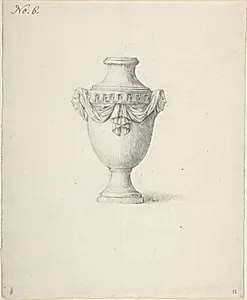
Medium
Pen and brown ink, graphite
Dimensions
7 1/2 x 9 3/16 in. (19.1 x 23.4 cm)
Classification
Drawings
Department
Drawings and Prints
Museum
Metropolitan Museum of Art, New York, NY
Credit
Gift of Raphael Esmerian, 1963
Accession Number
63.547.12
Rights
Public Domain
Tags
Art Historical Context
This delicate *Design for an Urn created by an anonymous French artist around 1770–90, captures the elegance of late 18th-century decorative arts. Executed in pen and brown ink with graphite on paper (7 1/2 x 9 3/16 in.), it exemplifies the preparatory sketches used by artisans to plan ornate objects like vases or funerary urns. During this era, France transitioned from the playful Rococo style to the more restrained Neoclassicism, and such designs often adorned silverwork, ceramics, or furniture, blending classical motifs with refined ornamentation. The drawing's tags—Heads and Urns—highlight its focus on symbolic elements: profile heads evoking antiquity and gracefully proportioned urn shapes inspired by Greco-Roman vessels. Graphite underdrawing provided a fluid guide for the precise brown ink lines, a technique prized for its clarity in workshops where designs were scaled up for production. This anonymous work reflects the collaborative craft of the period's *menuisiers* (cabinetmakers) and silversmiths, whose innovations influenced Europe's luxury goods trade. Generously gifted to the Metropolitan Museum of Art in 1963 by Raphael Esmerian, this sheet offers a window into the unsung creativity behind opulent 18th-century interiors, reminding us how humble sketches birthed timeless splendor.
About the Artist
Anonymous, French, 18th century · 1700–1800
The artist known as Anonymous, French, 18th century, represents a collective of unidentified talents active roughly between 1700 and 1800, a period of profound artistic evolution in France from the opulent Rococo to the austere dawn of Neoclassicism and Revolutionary fervor. Little is documented about their personal training or mentors, as their anonymity obscures individual biographies, though th...