
Design for a Lidded Tureen
ca. 1770–90
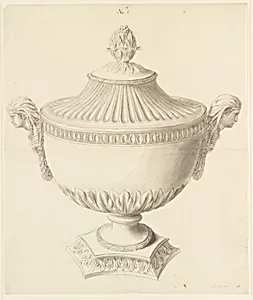
Medium
Pen and gray and rose ink, brush and gray wash, over graphite underdrawing
Dimensions
17 13/16 x 14 9/16 in. (45.3 x 37 cm)
Classification
Drawings
Department
Drawings and Prints
Museum
Metropolitan Museum of Art, New York, NY
Credit
Gift of Raphael Esmerian, 1963
Accession Number
63.547.19
Rights
Public Domain
Tags
Art Historical Context
This delicate drawing, titled *Design for a Lidded Tureen*, captures the elegance of late 18th-century French decorative arts. Created anonymously around 1770–90, it served as a preparatory blueprint for a luxurious serving vessel used for soups or stews at grand banquets. During this era, transitioning from the opulent Rococo to the refined Neoclassicism of Louis XVI's court, tureens were status symbols crafted in porcelain, silver, or gold by renowned manufactories like Sèvres. Such designs highlight France's leadership in high-end tableware, blending functionality with artistic flourish. Executed on a generous sheet measuring 17 13/16 x 14 9/16 inches, the work employs sophisticated mixed media: graphite underdrawing for precise outlines, pen with gray and rose inks for intricate details, and brush with gray wash for subtle shading and depth. These techniques, common in ateliers, allowed designers to convey texture, form, and even proposed gilding or enamel colors, bridging the gap between sketch and finished object. Housed in the Metropolitan Museum of Art's Drawings and Prints department since a 1963 gift from Raphael Esmerian, this piece offers a window into the collaborative world of 18th-century craftsmanship. It reminds us how anonymous hands shaped the splendor of Versailles-era dining, where every utensil told a story of refinement and abundance.
About the Artist
Anonymous, French, 18th century · 1700–1800
The artist known as Anonymous, French, 18th century, represents a collective of unidentified talents active roughly between 1700 and 1800, a period of profound artistic evolution in France from the opulent Rococo to the austere dawn of Neoclassicism and Revolutionary fervor. Little is documented about their personal training or mentors, as their anonymity obscures individual biographies, though th...