
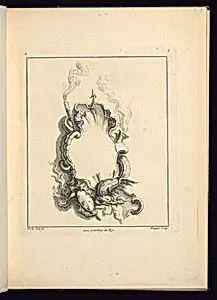
Design for Cartouche: Allegory of Fire
Classification
ornament
Department
Smithsonian Collection
Museum
Smithsonian American Art Museum
Credit
Purchased for the Museum by the Advisory Council
Accession Number
1921-6-326-2
Rights
Public Domain
About this artwork
Research in Progress
Art Historical Context
Jacques de Lajoüe (1687–1761), a prominent French artist of the Rococo era, *Design for Cartouche:ory of Fire* in 1740. This delicate ornamental drawing exemplifies the playful elegance of Rococo design, a style that flourished in 18th-century France under XV. De Lajoüe, as a painter and architect, specialized in intricate decorative motifs for architecture, furniture, and prints, blending fantasy with refined asymmetry. A cartouche is a scrolled, ornamental frame often used to enclose coats of arms, titles, or symbolic scenes in grand interiors or engravings. Here, it allegorizes the element of fire—likely evoking flames, mythological figures like Vulcan, or radiant motifs to symbolize passion and transformation. Such allegories were popular in the decorative arts, infusing everyday objects with poetic grandeur and reflecting the era's fascination with the natural elements. Acquired for the Smithsonian American Art Museum through the Advisory Council, this work highlights transatlantic appreciation for French ornamental mastery. Though research continues, it invites us to marvel at Rococo's whimsical beauty, bridging art and design in a single, fiery flourish.