
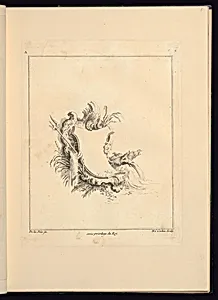
Design for Cartouche Evoking the Sea
Classification
ornament
Department
Smithsonian Collection
Museum
Smithsonian American Art Museum
Credit
Purchased for the Museum by the Advisory Council
Accession Number
1921-6-326-5
Rights
Public Domain
About this artwork
Research in Progress
Art Historical Context
This charming design for a cartouche, created in1740 by the French Jacques de Lajoüe belongs to the lively world of Rococo ornament. A cartouche is an elaborate, often scrolling frame used to surround inscriptions, coats of arms, or purely decorative motifs. The title tells us this particular invention evokes the sea, so we can imagine curling waves, shells, and fluid, watery forms typical of the period’s delight in nature and fantasy. Lajoüe (1687–1761) worked at the height of the Rococo style under Louis XV, when French designers supplied models for architects, furniture makers, and interior decorators across Europe. Such drawings were not finished pictures but working ideas that craftsmen translated into wood, plaster, metal, or stone. They helped spread the light, asymmetrical, and richly ornamental language that defined mid-eighteenth-century taste. Although the exact medium of this sheet is unrecorded, its classification as an ornament reminds us how central these inventive designs were to the decorative arts. Now in the Smithsonian American Art Museum, the work offers visitors a glimpse of the inventive spirit that once animated palaces and private interiors alike.