
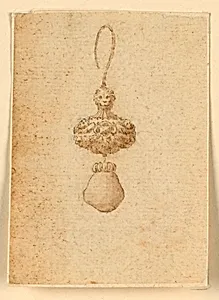
Design for earring with lion's head and diamond
16th century
Classification
jewelry
Department
Smithsonian Collection
Museum
Smithsonian American Art Museum
Credit
Museum purchase through gift of various donors and from Eleanor G. Hewitt Fund
Accession Number
1938-88-5028
Rights
Public Domain
About this artwork
Research in Progress
Art Historical Context
This exquisite *Design for Earring with Lion's Head and Diamond* from the 16th century offers a glimpse into Renaissance-era jewelry artistry. Crafted as a conceptual sketch—likely intended for a wearable pendant earring—the design centers a fierce lion's head, a motif symbolizing strength, courage, and nobility in European heraldry and classical mythology. The inclusion of a diamond highlights the era's fascination with precious gems, which were prized for their rarity and believed to hold protective powers. Dating to the 1500s, this piece reflects the Renaissance revival of intricate goldsmithing and gem-setting techniques, where jewelers drew inspiration from ancient motifs to create luxurious adornments for the elite. Though the exact medium remains undocumented, such designs were typically rendered in ink, metalpoint, or gouache on paper, serving as blueprints for skilled artisans to fabricate ornate pieces using enameling, chasing, and faceted stones. Acquired through museum purchase with contributions from various donors and the Eleanor G. Hewitt Fund, this artifact resides in the Smithsonian American Art Museum's collection. With research ongoing, it invites visitors to ponder the blend of ferocity and finesse in Renaissance decorative arts, bridging fine art and personal ornamentation.
About the Artist
Unknown
The artist designated as "Unknown" in our virtual museum's collection exemplifies a poignant chapter in art history: creators whose identities have faded into obscurity despite the enduring power of their work. With only one known artwork attributed to them in our holdings, this figure represents countless anonymous hands that shaped visual culture across centuries. Museums worldwide, including th...