
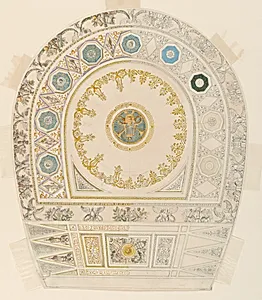
Design for Theater Ceiling
Classification
theater
Department
Smithsonian Collection
Museum
Smithsonian American Art Museum
Credit
Museum purchase from the Mary Hearn Greims Fund
Accession Number
1940-21-23
Rights
Public Domain
About this artwork
Research in Progress
Art Historical Context
Giuseppe Borsato, a artist active during Italy's vibrant early 19th century (1770–1840), created this *Design for Theater Ceiling* around 1820. Theaters were cultural epicenters in Italy, especially Venice, where elaborate interiors blended architecture, painting, and illusion to transport audiences into grand spectacles. Borsato's work reflects this tradition, likely envisioning a decorative scheme for a theater's overhead expanse—think soaring frescoes, mythological figures, or architectural fantasies that drew the eye upward. Though the medium remains unidentified amid ongoing research, such designs were pivotal in the Neoclassical era, emphasizing harmony, perspective, and opulence amid post-Napoleonic revival. Acquired through the Smithsonian American Art Museum's Mary Hearn Greims Fund, this piece highlights cross-cultural exchanges, bringing Italian theatrical artistry to American shores. It invites us to imagine the hush of an audience beneath its celestial canopy, a testament to art's power to elevate everyday wonder.