
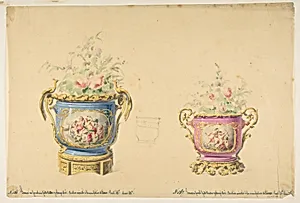
Design for Two Sèvres Porcelain Flower Pots
19th century
Medium
Graphite, watercolor, gouache, and gold gilt
Dimensions
sheet: 11 1/4 x 16 5/8 in. (28.6 x 42.2 cm)
Classification
Drawings
Department
Drawings and Prints
Museum
Metropolitan Museum of Art, New York, NY
Credit
The Elisha Whittelsey Collection, The Elisha Whittelsey Fund, 1953
Accession Number
53.675.23
Rights
Public Domain
Tags
Art Historical Context
This delicate 19th-century design sheet offers a window into the meticulous creative process behind Sèvres porcelain, France’s celebrated national manufactory. Created anonymously by a French artist, the drawing presents two ornate flower pots rendered in graphite, watercolor, gouache, and shimmering gold gilt. Such preparatory works guided the production of luxury decorative objects that combined sculptural form with vibrant surface decoration, reflecting the era’s taste for refined, nature-inspired elegance in aristocratic and bourgeois homes. The medium’s layered techniques—precise line work for structure, translucent washes for depth, and applied gilt for opulence—highlight the collaborative artistry between draftsmen and porcelain painters at Sèvres. These designs ensured that final pieces achieved the manufactory’s renowned standards of technical perfection and aesthetic harmony. Acquired by the Metropolitan Museum through the Elisha Whittelsey Fund, the sheet preserves a rare glimpse of the planning stage that transformed simple clay into exquisite floral vessels. Floral motifs dominate the composition, underscoring the 19th-century fascination with botany and the symbolic language of flowers in decorative arts. As a working drawing rather than a finished object, it reminds viewers of the skilled hands and careful planning required to produce Sèvres ware, which remained a symbol of French cultural prestige throughout the century.
About the Artist
Anonymous, French, 19th century · 1800–1900
**Anonymous, French, 19th Century (ca. 1800–1900)** The artist cataloged as Anonymous, French, 19th century embodies the enigmatic yet essential contributions of unidentified creators to France's vibrant 19th-century art world. Active roughly between 1800 and 1900, this figure—or potentially collective workshop—produced a diverse array of works amid the nation's transition from Neoclassicism thro...