
Design for Victoria Sleigh, no. 3736
1882
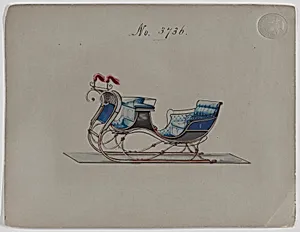
Medium
Pen and black ink, watercolor and gouache with gum arabic
Dimensions
sheet: 7 1/16 x 9 1/4 in. (17.9 x 23.5 cm)
Classification
Drawings
Department
Drawings and Prints
Museum
Metropolitan Museum of Art, New York, NY
Credit
Gift of William Brewster, 1923
Accession Number
23.112.1240
Rights
Public Domain
Tags
Art Historical Context
In the opulent Gilded Age of 1882, New York-based Brewster & Co., a premier coachbuilding firm renowned for crafting luxury carriages and sleighs for America's elite, produced this exquisite design drawing for the "Victoria Sleigh, no. 3736." Named after Queen Victoria's favored carriage style, this sleigh epitomized winter elegance—lightweight, open-top, and adorned with intricate details for leisurely snow drives among high society. The drawing, a preparatory blueprint, captures the firm's mastery in blending functionality with lavish ornamentation, reflecting the era's obsession with status symbols amid rapid industrialization. Rendered on a modest 7 1/16 x 9 1/4-inch sheet, the work employs pen and black ink for precise lines, enhanced by watercolor and gouache heightened with gum arabic for luminous, glossy finishes. This mixed-media technique, common in 19th-century design ateliers, allowed Brewster's draftsmen to vividly convey textures like polished wood, velvet upholstery, and gleaming runners, aiding client approvals and workshop execution. Gum arabic, a natural binder, added depth and sheen, mimicking the sleigh's real opulence. Today, this gift to the Metropolitan Museum of Art from William Brewster in 1923 preserves a snapshot of vanished equestrian luxury, bridging fine art and functional design in the Drawings and Prints collection. It invites us to imagine crisp winter outings in a bygone world of horse-drawn splendor.
About the Artist
Brewster & Co. · 1837–present
**Brewster & Co.** Brewster & Company, a premier American coachbuilder renowned for its exquisite carriage designs, was established in 1810 in New Haven, Connecticut, by James Brewster (1788–1866). Born in 1788, Brewster trained as a wagonmaker's apprentice starting at age 16 in Northampton, Massachusetts, before relocating to New Haven, where he set up his workshop and quickly gained acclaim for...