
Design for Wall Panel
18th century
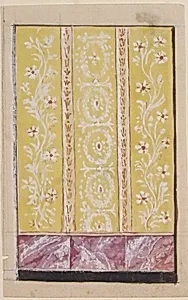
Medium
Graphite, watercolor and gouache
Dimensions
7 x 4 5/8 in. (17.8 x 11.7 cm)
Classification
Drawings|Ornament & Architecture
Department
Drawings and Prints
Museum
Metropolitan Museum of Art, New York, NY
Credit
The Elisha Whittelsey Collection, The Elisha Whittelsey Fund, 1949
Accession Number
49.50.175
Rights
Public Domain
Tags
Art Historical Context
This delicate *Design for Wall Panel*, by an anonymous French artist in the 18 century, exemplifies the ornate decorative arts of the Rococo era Rendered in graphite, watercolor, and gouache on a modest 7 x 4 5/8 in. (17.8 x 11.7 cm) sheet, it features floral motifs—likely blooming flowers in rhythmic patterns—intended as a blueprint for elegant interior paneling. Such preparatory drawings were essential for architects and decorators, guiding the translation of intricate designs into luxurious wall treatments for salons and chateaux. The mixed media technique highlights 18th-century mastery: graphite provided precise underdrawings for symmetry and detail, while watercolor offered translucent vibrancy and gouache added opaque richness, mimicking the textures of carved boiseries or painted panels. Flowers, a hallmark of French ornamental style, symbolized abundance and grace, reflecting the period's fascination with nature's opulence amid Enlightenment refinement. Housed in the Metropolitan Museum of Art's Drawings and Prints department as part of The Elisha Whittelsey Collection (acquired 1949), this anonymous gem offers a window into the collaborative world of French design, where artistry met craftsmanship to adorn aristocratic spaces.
About the Artist
Anonymous, French, 18th century · 1700–1800
The artist known as Anonymous, French, 18th century, represents a collective of unidentified talents active roughly between 1700 and 1800, a period of profound artistic evolution in France from the opulent Rococo to the austere dawn of Neoclassicism and Revolutionary fervor. Little is documented about their personal training or mentors, as their anonymity obscures individual biographies, though th...