
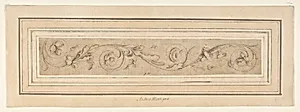
Design of Rinceaux
1470–1510
Medium
Pen and brown ink, over traces of construction lines in black chalk or leadpoint
Dimensions
1 7/8 x 11 1/4in. (4.7 x 28.5cm)
Classification
Drawings
Department
Drawings and Prints
Museum
Metropolitan Museum of Art, New York, NY
Credit
Rogers Fund, 1966
Accession Number
66.248
Rights
Public Domain
Tags
Art Historical Context
Andrea Mantegna (1431–1506), a pioneering Italian Renaissance artist from Padua and Mantua, crafted this exquisite *Design of Rinceaux between 1470 and1510. Rendered in pen and brown ink over faint construction lines in black chalk orpoint, the narrow sheet (just 1 7/8 x 11 1/4 inches) reveals Mantegna's meticulous preparatory process for ornamental motifs. Housed in the Metropolitan Museum of Art's Drawings and Prints department, entered the collection through the Rogers Fund in 1966. Rinceaux—flowing, scrolling patterns of intertwined vines, leaves, and flowers—were a hallmark of Renaissance decorative arts, drawing inspiration from ancient Roman frescoes and architecture. Mantegna, renowned for his innovative use of perspective and classical motifs in works like the *Camera degli Sposi* frescoes, elevated these designs with precise, linear elegance. This drawing likely served as a model for architectural embellishments or book illustrations, showcasing his ability to blend natural forms with geometric harmony. The subtle underdrawing highlights Mantegna's technical rigor, allowing fluid yet controlled ink lines that evoke vitality in foliage. A testament to the Renaissance revival of antiquity, this modest sheet offers visitors a intimate glimpse into the mind of a master draftsman, bridging art and ornament in profound ways.
About the Artist
Andrea Mantegna · 1431–1506
Andrea Mantegna was born around 1431 near Padua, in the Venetian Republic, the son of a carpenter. At approximately age eleven he was taken into the workshop of the Paduan painter and antiquities collector Francesco Squarcione, who enrolled him as a guild member and immersed him in the study of Roman sculpture and classical Latin. Though Mantegna later claimed that Squarcione had exploited his lab...