
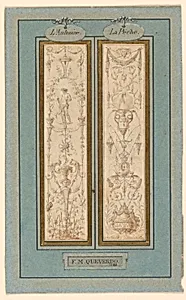
Designs for Arabesque Panels
Classification
drawing
Department
Smithsonian Collection
Museum
Smithsonian American Art Museum
Credit
Purchased for the Museum by the Advisory Council
Accession Number
1911-28-259-a
Rights
Public Domain
About this artwork
Research in Progress
Art Historical Context
**Designs for Arabesque** *François Marie Isidoreverdo (1748–1797), 1788* Drawing; Smithsonian American Art Museum, Smithsonian Collection. Purchased for the Museum by the Advisory Council. Step into the elegant world of late 18th-century French with François Marie Isidore Quever's *Designs foresque Panels*, a delicate drawing from 1788 Created by this French artist and architect during a time of artistic transition just before the French Revolution, work presents intricate patterns meant for decorative panels—likely intended for furniture, walls, or architectural elements. Arabesques, with their flowing scrolls, foliage, and whimsical motifs, were a hallmark of European ornamental art, evoking fantasy and refinement. As a preparatory drawing, this reveals the meticulous planning behind grand interiors, where every curve contributed to opulent spaces. Queverdo's style reflects the era's blend of Rococo playfulness and Neoclassical poise, showcasing how drawings served as blueprints for artisans. Though the exact medium remains unidentified and research is ongoing, its presence in the Smithsonian American Art Museum underscores the global exchange of decorative ideas that influenced early American aesthetics. This charming artifact invites us to trace the artistry hidden in sketches, reminding visitors how a single design could transform a room into a symphony of elegance. (198 words)