
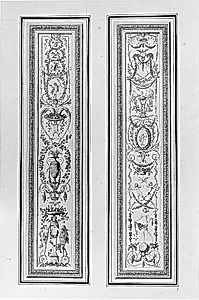
Two Arabesque Panel Designs
Classification
Bound print
Department
Smithsonian Collection
Museum
Smithsonian American Art Museum
Credit
Purchased for the Museum by the Advisory Council
Accession Number
1921-6-204-17
Rights
Public Domain
About this artwork
Research in Progress
Art Historical Context
**Two Arabesque Panel Designs by French ornamentalist Gilles Paul Cauvet1731–1788) dates to 1776, a pivotal moment in the transition from Rococo exuberance to Neoclassical elegance under Louis XVI. Presented as a bound print—likely an engraved design from an album intended for architects and artisans—these panels showcase Cauvet's mastery of arabesque motifs. Arabesques, with their sinuous vines, fantastical creatures, and delicate interlacing, drew from Renaissance grotesques but evolved into lighter, more refined patterns perfect for wall panels, furniture, and interiors. Cauvet, a leading figure in Parisian decorative arts, supplied designs to royal workshops and elite clientele, blending symmetry with whimsy. Created amid France's Enlightenment fervor, these works reflect the era's fascination with antiquity-inspired ornamentation, influencing furnishings that graced Versailles and beyond. Though the exact medium remains under study, their bound format underscores their practical role as reproducible templates for craftsmen. Housed in the Smithsonian American Art Museum's collection, acquired through the Advisory Council, these designs offer a window into 18th-century luxury and ingenuity. They remind us how printed patterns democratized high-style decoration, bridging art and everyday elegance. (198 words)