
Designs for Leather
19th century
Medium
Woodblock print (surimono); ink and color on paper
Dimensions
5 9/16 x 7 1/4 in. (14.1 x 18.4 cm)
Classification
Prints
Culture & Period
Japan · Edo period (1615–1868)
Department
Asian Art
Museum
Metropolitan Museum of Art, New York, NY
Credit
H. O. Havemeyer Collection, Bequest of Mrs. H. O. Havemeyer, 1929
Accession Number
JP1987
Rights
Public Domain
Tags
Art Historical Context
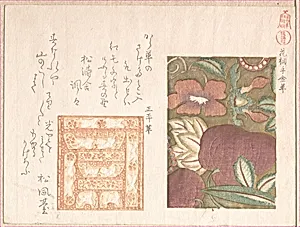
Kubo Shunman's *Designs for Leather* is a exquisite example of 19th-century Japanese surimono, a luxurious form of woodblock print produced in small editions for private patrons, often poetry enthusiasts or New Year's greetings. This intimate work, measuring just 5 9/16 x 7 1/4 inches, features intricate floral and leafy motifs in vibrant inks and colors on paper—patterns likely intended as templates for leather goods, blending fine art with practical design. Created during Japan's Edo period (1615–1868), when ukiyo-e prints captured the floating world's elegance, Shunman's piece showcases his mastery of the medium. Surimono like this one employed advanced techniques such as precise color registration, subtle gradients (bokashi), and sometimes embossing or mica for a tactile shimmer, elevating them beyond mass-produced prints. As a versatile artist known for landscapes, figures, and designs, Shunman bridged artistic expression with everyday crafts, reflecting Edo Japan's vibrant commerce and aesthetic refinement. Housed in the Metropolitan Museum of Art's Asian Art collection as part of the renowned H. O. Havemeyer bequest, this print highlights the global appeal of Japanese woodblocks. It invites us to appreciate how delicate nature motifs inspired luxury items, embodying the period's harmonious fusion of beauty and utility.
About the Artist
Kubo Shunman · 1757–1820
Japanese, 1757–1820