
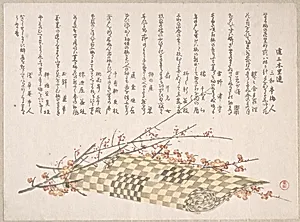
Plum Branches with Flowers and a Rolled Mat
19th century
Medium
Part of an album of woodblock prints (surimono); ink and color on paper
Dimensions
6 1/8 x 11 in. (15.6 x 27.9 cm)
Classification
Prints
Culture
Japan
Department
Asian Art
Museum
Metropolitan Museum of Art, New York, NY
Credit
H. O. Havemeyer Collection, Bequest of Mrs. H. O. Havemeyer, 1929
Accession Number
JP2347
Rights
Public Domain
Tags
Art Historical Context
Kubo Shunman's *Plum Branches with Flowers a Rolled Mat* (19th century) is a delicate gem from a surimono album—a type of luxurious, privately commissioned woodblock print popular in Edo-period Japan. These intimate works, often produced for New Year's celebrations or poetry gatherings, showcase the artist's mastery of ukiyo-e, blending ink and vibrant colors on paper to create small-scale masterpieces measuring just 6 1/8 x 11 inches. Shunman, a multifaceted talent as both printmaker and poet, elevated surimono with his refined compositions and subtle embellishments like metallic pigments or embossing, reserved for elite patrons. The print captures blooming plum branches—symbols of resilience and the promise of spring amid winter's chill—gracefully arching over a rolled mat, evoking a serene domestic interior. Plum blossoms held deep cultural resonance in Japan, representing perseverance and renewal, often featured in art to welcome the season's turn. Shunman's precise lines and layered colors highlight the translucent petals and textured bark, demonstrating woodblock printing's ability to mimic nature's ephemerality on paper. Housed in the Metropolitan Museum of Art's Asian Art Department as part of the prestigious H. O. Havemeyer Collection (1929), this piece invites visitors to appreciate the poetic elegance of Japanese print culture, where everyday beauty intertwined with seasonal symbolism and artistic innovation.
About the Artist
Kubo Shunman · 1757–1820
Japanese, 1757–1820