
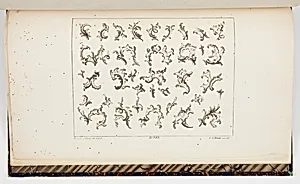
Designs for Rocaille Motifs
mid- 18th century
Classification
Department
Smithsonian Collection
Museum
Smithsonian American Art Museum
Credit
Purchased for the Museum by the Advisory Council
Accession Number
1921-6-317-69
Rights
Public Domain
About this artwork
Research in Progress
Art Historical Context
**Designs for Rocaille Motifs** Georg Leopold Hertel, a German artist active around 1780, created this mid-18th-century print as part of the Smithsonian American Art Museum's collection. As a set of designs, it showcases intricate rocaille motifs—those playful, asymmetrical shell-like forms that define the Rococo style. Rococo emerged in early 18th-century France and spread across Europe, favoring ornate decoration over the grandeur of Baroque, often adorning furniture, architecture, and silverware with whimsical curves and natural inspirations. These motifs were more than aesthetic flourishes; they reflected the era's cultural shift toward lightness, elegance, and intimacy in aristocratic interiors. Hertel's work, purchased for the museum by the Advisory Council, exemplifies how prints served as practical templates for artisans, disseminating sophisticated designs from courts to workshops. Though the exact medium remains under research, its classification as a print highlights the period's innovative use of engraving and etching to capture fine details, making high-style ornamentation accessible. Today, this piece invites us to appreciate Rococo's enduring charm, bridging art and craft in a time of lavish creativity. A delightful glimpse into 18th-century design ingenuity! (178 words)