
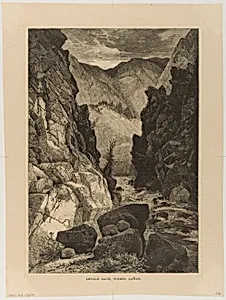
Devil's Gate, Weber Cañon
Classification
landscapes
Department
Smithsonian Collection
Museum
Smithsonian American Art Museum
Credit
Gift of Gilbert White Rose and Henry Martin Rose II
Accession Number
1945-69-9359
Rights
Public Domain
About this artwork
Research in Progress
Art Historical Context
Thomas Moran's *Devil's Gate, Cañon* (1874) captures the dramatic ruggedness of Utah's Weber Canyon, a pivotal site during the American West's expansion. Born in Britain and later a key figure in American art, Moran1837–1926) was renowned for his luminous landscapes that celebrated the nation's untamed wilderness. This painting depicts Devil's Gate, a striking natural rock formation that served as a challenging landmark for the Union Pacific Railroad's construction in the 1860s, symbolizing triumph over formidable terrain. As a member of the Hudson River School, Moran infused his works with romantic grandeur, using rich colors and atmospheric light to evoke the sublime power of nature. Though the medium is undocumented, his typical oil or watercolor techniques emphasized texture and depth, drawing viewers into vast, awe-inspiring scenes. Created just years after the transcontinental railroad's completion, the artwork reflects a era of national optimism and Manifest Destiny, helping to popularize the West's beauty. Housed in the Smithsonian American Art Museum through a generous gift from Gilbert White Rose and Henry Martin Rose II, *Devil's Gate* invites us to ponder how art bridged exploration and preservation, influencing the conservation movement that would birth places like Yellowstone National Park. A testament to Moran's legacy, it reminds us of America's wild heart.