
Dice
Unknown Artist
9th–10th century
Medium
Bone; incised and inlaid with paint
Dimensions
H. 1/4 in. (0.6 cm) W. 1/4 in .(0.6 cm) D. 1/4 in. (0.6 cm)
Classification
Gaming pieces
Department
Islamic Art
Museum
Metropolitan Museum of Art, New York, NY
Credit
Rogers Fund, 1948
Accession Number
48.101.211a
Rights
Public Domain
Tags
Art Historical Context
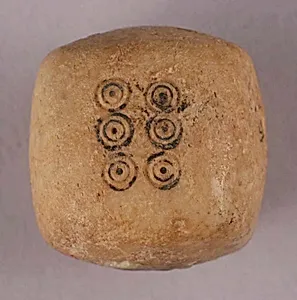
Nestled in the Metropolitan Museum of Art's Islamic collection, this diminutive bone die from the 9th–10th century exemplifies the everyday artistry of the medieval Islamic world. Measuring just a quarter-inch on each side, this tiny cube was crafted as a gaming piece, likely in backgammon or similar games popular across the Abbasid Caliphate. modest size belies the skill involved, offering a glimpse into leisure activities that bridged social classes, from merchants in bustling Baghdad markets to travelers along trade routes. The die's surface features incised markings—precisely carved lines filled with colorful paint inlays, a technique that enhanced visibility and durability during play. Bone, a readily available material, was ideal for such portable objects, reflecting resourcefulness in craftsmanship. While gaming was occasionally debated in Islamic scholarship for its ties to chance, these artifacts highlight how play intertwined with daily life, culture, and even mathematical thinking in early Islamic societies. Acquired through the Rogers Fund in 1948, this unassuming piece invites us to appreciate the unsung artistry of anonymous makers, whose precision turned simple tools into enduring treasures.