
Disegni Varij di Polifilo Zancarli (Friezes)
Medium
etching
Dimensions
Plate: 5 1/16 x 17 3/16 in. (12.8 x 43.7 cm)
Classification
Prints|Ornament & Architecture
Department
Drawings and Prints
Museum
Metropolitan Museum of Art, New York, NY
Credit
The Elisha Whittelsey Collection, The Elisha Whittelsey Fund, 1949
Accession Number
49.20.13(4)
Rights
Public Domain
Tags
Art Historical Context
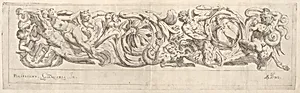
This striking etching, created around 1625, belongs to a series of ornamental frieze designs titled *Disegni Varij di Polifilo Zancarli*. Attributed to the Italian artist Polifilo Giancarli with contributions from Odoardo Fialetti, the work exemplifies the Baroque era’s fascination with classical mythology and decorative pattern books. Printed in a long, horizontal format ideal for architectural borders, it was intended as a model for artists, craftsmen, and architects seeking inspiration for friezes, furniture, or interior decoration. The composition teems with dynamic mythological figures—graceful female nudes intertwined with centaurs, satyrs, dragons, and serpents—rendered through the precise, fluid lines of etching. This medium allowed for intricate detail and wide circulation, making such ornamental prints essential tools in 17th-century design studios. The elongated plate captures a sense of movement and fantasy, blending human and animal forms in rhythmic procession. Housed in the Metropolitan Museum of Art’s Department of Drawings and Prints, this piece highlights the enduring appeal of classical motifs during the early modern period. Its classification as both a print and an architectural ornament underscores how artists like Giancarli and Fialetti bridged fine art and applied design, influencing decorative traditions across Europe.
About the Artist
Polifilo Giancarli|Odoardo Fialetti (Italian|Italian) · 1600 |1573 –1625 |1638
active in Venice ca. 1600–1625|Italian, Bologna 1573–1637/38 Venice