
Dish
Unknown Artist
last quarter 16th century
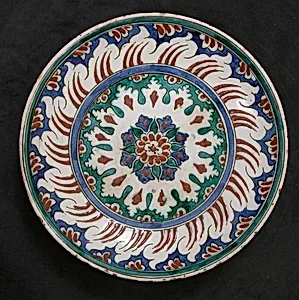
Medium
Stonepaste; painted and glazed
Dimensions
H. 2 1/4 in. (5.7 cm) Diam. 11 1/2 in. (29.2 cm) Wt.1.9lb. (0.9kg)
Classification
Ceramics
Department
Islamic Art
Museum
Metropolitan Museum of Art, New York, NY
Credit
Gift of William B. Osgood Field, 1902
Accession Number
02.5.43
Rights
Public Domain
Art Historical Context
This elegant dish, crafted by an unknown artist in the quarter of the 16 century, exemplifies the refined ceramics of the Islamic world. Measuring 11½ inches in diameter and just 2¼ inches high it was designed for practical use—likely serving sweets, fruits, or spiced delicacies at grand feasts. Its shallow form and sturdy 1.9-pound weight made it both functional and display-worthy in affluent households. Made from stonepaste—a innovative composite of quartz, white clay, and glass frit—this medium was a hallmark of Islamic potters from the 13th century onward. Unable to access true Chinese porcelain, artisans developed stonepaste to achieve a smooth, white body that held intricate painted designs under a glossy glaze. The technique allowed vibrant colors and detailed motifs to shine through, blending utility with artistry in regions like Persia, Syria, or the Ottoman Empire. Now in the Metropolitan Museum of Art's Islamic Art Department, thanks to a 1902 gift from William B. Osgood Field, this dish offers a window into Renaissance-era Islamic culture, where ceramics bridged everyday life and aesthetic splendor. Visitors, imagine it gracing a bustling 16th-century table!