
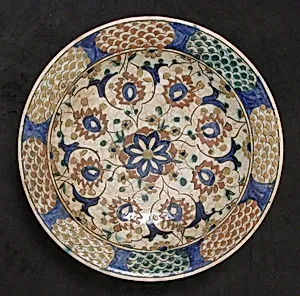
Dish
Unknown Artist
first half 17th century
Medium
Stonepaste; underglaze painted in black, blue, and green with red and yellow slips
Dimensions
D. 13 1/2 in. (34.3 cm)
Classification
Ceramics
Department
Islamic Art
Museum
Metropolitan Museum of Art, New York, NY
Credit
Mr. and Mrs. Isaac D. Fletcher Collection, Bequest of Isaac D. Fletcher, 1917
Accession Number
17.120.95
Rights
Public Domain
Art Historical Context
This elegant dish, crafted by an unknown artist in the half of the 17 century, exemplifies the refined ceramics of the Islamic world. Produced during a golden age of artistic exchange across the Ottoman, Safavid, and empires, such pieces were essential for dining and display in affluent households. Measuring 13½ inches in diameter, it the practical yet luxurious scale of tableware from regions like Iran or Turkey, where pottery workshops thrived amid vibrant trade routes. The dish's medium—stonepaste, a composite of quartz, clay, and frit—created a durable, ivory-white body prized for its ability to mimic porcelain, which was rare in the West at the time. Artisans applied underglaze pigments in black, blue, and green before glazing and firing, ensuring colors bonded permanently for everyday use. Red and yellow slips, thin clay mixtures, added vivid accents, showcasing technical innovation that allowed bold, multifaceted designs often featuring floral or geometric motifs symbolic of paradise gardens in Islamic culture. Housed in the Metropolitan Museum of Art's Islamic Art department as part of the Isaac D. Fletcher bequest, this dish highlights the global appeal of Islamic ceramics, blending utility with aesthetic splendor for both patrons and collectors today.