
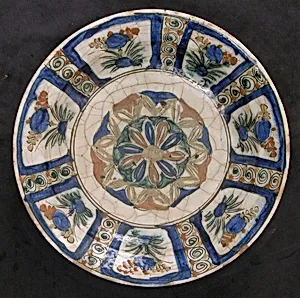
Dish
Unknown Artist
17th century
Medium
Stonepaste; underglaze painted in black, blue, and green with red and yellow slips
Dimensions
H. 2 13/16 in. (7.1 cm) Diam. 13 5/16 in. (33.8 cm) Wt. 41.6 oz. (1179.5 g)
Classification
Ceramics
Department
Islamic Art
Museum
Metropolitan Museum of Art, New York, NY
Credit
Mr. and Mrs. Isaac D. Fletcher Collection, Bequest of Isaac D. Fletcher, 1917
Accession Number
17.120.94
Rights
Public Domain
Art Historical Context
This elegant 17th-century dish, crafted from stonepaste—a durable composite of quartz, clay, and frit glass developed by Islamic potters to rival Chinese porcelain—exemplifies the technical virtuosity of Middle Eastern ceramics. Measuring 13 5/16 inches in diameter and weighing a substantial 41.6 ounces, its shallow form was ideal for serving fruits, sweets, or communal meals, reflecting the hospitality central to Islamic culture. The artwork's decoration features underglaze painting in vivid black, blue, and green, enriched with red and yellow slips—liquid clay applied before glazing and firing. This labor-intensive technique, perfected in regions like Persia and Syria during the Safavid and Ottoman eras, allowed colors to fuse permanently beneath a glossy transparent glaze, ensuring brilliance and longevity. Though the artist remains unknown, such dishes often bore floral motifs or geometric patterns symbolizing paradise gardens, blending artistry with spiritual resonance. Now in the Metropolitan Museum of Art's Islamic Art Department, thanks to the 1917 bequest of Mr. and Mrs. Isaac D. Fletcher, this piece invites us to savor the ingenuity of artisans who transformed everyday objects into treasures, bridging centuries of culinary tradition and aesthetic innovation.