
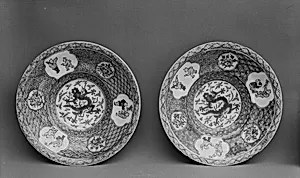
Dish
Unknown Artist
19th century
Medium
White porcelain decorated with iron polychrome enamels (Hizen ware, Kutani type)
Dimensions
Diam. 8 in. (20.3 cm)
Classification
Ceramics
Culture & Period
Japan · Edo (1615–1868) or Meiji period (1868–1912)
Department
Asian Art
Museum
Metropolitan Museum of Art, New York, NY
Credit
Gift of Charles Stewart Smith, 1893
Accession Number
93.3.508
Rights
Public Domain
Tags
Art Historical Context
This exquisite 19th-century Japanese, measuring 8 inches in diameter, exemplifies the artistry of Hizen ware executed in the vibrant Kutani type. Crafted from fine white porcelain, it is with iron polychrome enamels—overglaze colors fired at lower temperatures to achieve bold reds, greens, and other hues that gleam with jewel-like intensity. The Kutani style, inspired by the famed Kutani kilns, brought exuberant polychromy toizen's renowned Arita porcelain production, blending technical precision with decorative flair. Dating to the late Edo period (1615–1868) or early Meiji era (1868–1912), this piece reflects Japan's porcelain mastery during a time of cultural transition—from feudal isolation to global trade. Hizen kilns in Saga Prefecture supplied both domestic markets and international exports, with motifs often featuring children, symbolizing playfulness, prosperity, and familial joy in everyday ceramics. A gift to the Metropolitan Museum of Art from Charles Stewart Smith in 3, this dish highlights early Western appreciation for Japanese artistry amid the Japonisme craze. Its enduring appeal lies in the harmonious fusion of subtle porcelain purity and lively enameling, inviting viewers to ponder the lives depicted in its colorful scenes.