
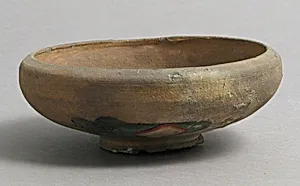
Dish, Deep
Unknown Artist
15th–16th century
Medium
Earthenware
Dimensions
Overall: 1 1/8 x 4 in. (2.9 x 10.2 cm)
Classification
Ceramics
Culture
French
Department
Medieval Art
Museum
Metropolitan Museum of Art, New York, NY
Credit
Gift of J. Pierpont Morgan, 1917
Accession Number
17.194.2212
Rights
Public Domain
Art Historical Context
This delicate deep dish, crafted in France during the 15th–16th centuries, exemplifies everyday earthenware from the late medieval period. Measuring just 1 1/8 x 4 inches (2.9 x 10.2 cm), its compact, bowl-like form suggests practical use in households—perhaps for serving sauces, dips, or small confections at the table. Earthenware, a fired clay medium, was prized for its affordability and durability, making it accessible beyond elite workshops and reflecting the democratized craft of ceramics in Renaissance-era France. Though produced by an unknown artisan, the dish highlights the evolution of French pottery during a time of cultural transition from Gothic traditions to early Renaissance influences. Simple yet functional, such pieces were often wheel-thrown and possibly glazed for water resistance, underscoring the era's blend of utility and subtle artistry. In the Medieval Art department of The Metropolitan Museum of Art, it stands as a humble survivor of domestic life, gifted by financier J. Pierpont Morgan in 1917. Today, this unassuming ceramic invites us to ponder the textures of history—objects that fed families and fueled daily rituals, bridging the gap between medieval hearths and modern curiosity.