
Plate
dated 1532
Medium
Maiolica (tin-glazed earthenware), lustered
Dimensions
Overall: 1 3/4 × 10 in. (4.4 × 25.4 cm)
Classification
Ceramics-Pottery
Culture
Italian, Gubbio
Department
European Sculpture and Decorative Arts
Museum
Metropolitan Museum of Art, New York, NY
Credit
Purchase, 1884
Accession Number
84.2.6
Rights
Public Domain
Tags
Art Historical Context
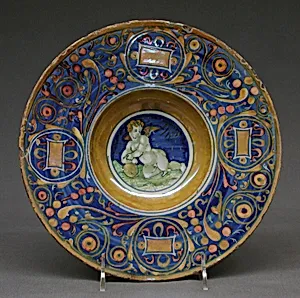
This elegant maiolica plate, created in 1532 by Maestro Giorgio Andreoli in Gubbio, Italy, represents the height of Renaissance ceramic artistry. Andreoli was renowned across Europe for perfecting luster techniques that transformed humble earthenware into objects of luminous beauty, often evoking the sheen of gold or silver. As a product of Gubbio’s famed workshops, the plate reflects the city’s central role in producing refined tableware for aristocratic patrons during the early 16th century. Made of tin-glazed earthenware with metallic luster, the medium allowed artists to achieve vibrant colors and an iridescent surface that caught the light dramatically. At just over ten inches wide, the plate would have served both practical and decorative purposes, perhaps displayed in a cabinet or used during festive meals. The inclusion of Cupid points to the Renaissance fascination with classical mythology and themes of love, rendered here with the delicate, narrative style typical of Andreoli’s workshop. Acquired by the Metropolitan Museum of Art in 1884, this work invites visitors to appreciate how everyday objects became vehicles for artistic innovation and cultural expression in Renaissance Italy.
About the Artist
Maestro Giorgio Andreoli · 1500–1550
**Maestro Giorgio Andreoli: The Luster Maestro of Gubbio** Giorgio di Pietro Andreoli, known as Maestro Giorgio or Mastro Giorgio da Gubbio, was born between 1465 and 1470 in Intra on Lake Maggiore, the son of potter Pietro Andreoli. After spending his youth in Pavia—where he was noted in documents as "son of Pietro da Pavia"—his family fled following the 1476 assassination of Duke Galeazzo Sforz...